Language: English | Espana

Download free Kraken PNG images and clipart with transparent backgrounds. This gallery includes Kraken PNG images free download and cutout images for web design, presentations, banners and creative projects.
In this Kraken PNG gallery, you can download 41 free PNG images with transparent backgrounds.
This gallery contains 41 PNG images with transparent backgrounds. Image dimensions range from 283x260 to 2500x2500 pixels.


The kraken (/ˈkræ.kən/; from Norwegian: kraken, /ˈkrɑː.kən/) is a legendary sea monster of enormous size, per its etymology something akin to a cephalopod, said to appear in the Norwegian Sea off the coast of Norway. It is believed that the legend of the Kraken may have originated from sightings of giant squid, which may grow to 10.5 metres (34 ft) in length.
The kraken, as a subject of sailors' superstitions and mythos, was first described in a Norwegian glossary by Christen Jensøn in 1646. Later this creature appears in a travelogue by Francesco Negri in 1700, followed in 1734 by an account from Dano-Norwegian missionary and explorer Hans Egede, who described the kraken in detail and equated it with the hafgufa of medieval lore. However, the first description of the creature is usually credited to the Danish bishop Pontoppidan (1753). He described the kraken as an octopus (polypus) of tremendous size, and wrote that it had a reputation for pulling down ships. The French malacologist Denys-Montfort, of the 19th century, is also known for his pioneering inquiries into the existence of gigantic octopuses.
The great man-hunting octopus entered French fiction when Victor Hugo introduced the pieuvre octopus of Guernsey lore in his 1866 novel Toilers of the Sea, which he identified with the kraken of legend. This led to Jules Verne's depiction of the kraken in his novel Twenty Thousand Leagues Under the Seas, although Verne did not distinguish between octopuses and squids.
Carl Linnaeus may have indirectly written about the kraken. Linnaeus wrote about the Microcosmus genus (an animal with various other organisms or growths attached to it, comprising a colony). Subsequent authors have referred to Linnaeus's writing, and the writings of Thomas Bartholin's cetus called hafgufa, and Christian Franz Paullini's monstrum marinum as "krakens". That said, the claim that Linnaeus used the word "kraken" in the margin of a later edition of Systema Naturae has not been confirmed.
The kraken was described as a many-headed and clawed creature by Hans Egede , who stated it was equivalent to the Icelanders' hafgufa, but the latter is commonly treated as a fabulous whale (the name meaning "sea reeker", compare a whale blowing water). Erik Pontoppidan (1753), who popularized the kraken to the world, noted that it was multiple-armed according to lore, and conjectured it to be a giant sea-crab, starfish or a polypus (octopus). Still, Pontoppidan is considered to have been instrumental in sparking interest for the kraken in the English-speaking world, as well as becoming regarded as the authority on sea-serpents and krakens.
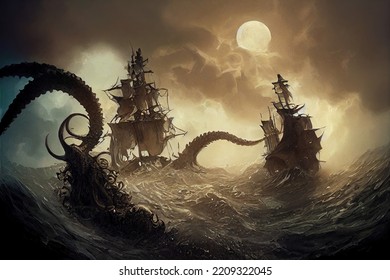
Denys-Montfort (1801) published on two giants, the "colossal octopus" with the enduring image of it attacking a ship, and the "kraken octopod", deemed to be the largest organism in zoology. Denys-Montfort matched his "colossal" with Pliny's tale of the giant polypus that attacked ships-wrecked people, while making correspondence between his kraken and Pliny's monster called the arbor marina. Finnur Jónsson (1920) also favored identifying the kraken as an inkfish (squid/octopus) on etymological grounds.
In this page you can download free PNG images: Kraken PNG images free download